
A camera that teaches, and film you have to develop
The camera has been in the game for a while as a toy: point it at a creature, press the trigger, and it files a score. Over four headset passes (46 to 49) it turned into a system. Pictures teach you about what you photog…
The camera has been in the game for a while as a toy: point it at a creature, press the trigger, and it files a score. Over four headset passes (46 to 49) it turned into a system. Pictures teach you about what you photograph, and what you learn pays out in loot. Then I changed when the learning happens. Here is what got built, what I saw in the headset, and the one thing that was invisible however much I thickened it.
The screen on the back
The first slice needed a way to see what the shutter would accept before pressing it. The camera now has a screen (Astra's mesh, slotted over the body) that draws a disc for every creature in frame. A disc is bright when the shutter would take the picture, dim when it would refuse (behind a wall, too far, not really in shot), and an amber diamond when the journal has never seen that creature.
The screen, the shutter and the old crystal on top all read one survey of what's in frame. There's a test for the case that matters: put a wall between camera and creature, and the disc dims on exactly the frame the shutter starts refusing. I broke the occlusion check to watch it fail before I trusted it.
In pass 46 I saw the dots "grow bigger and brighter when they got closer," which was the point. I also had to guess which button took the picture, and nothing happened when I pressed it. So pass 47 added a click (Kenney's switch_001, CC0), a short tick in the hand and a white flash on the screen, the same for every outcome. A hint along the bottom of the screen shows for the first three pickups. A creature already counted in this room turns into a hollow ring. All of it held in pass 47.
Study, and what it pays
A good picture scores at least 0.4, and counts once per creature per room. The once-per-room rule is the farming limit: it's tied to which creature it is, not to arithmetic, so standing in front of one orc pressing the trigger teaches you nothing extra. Study levels sit at 1, 3, 8, 15 and 30 good pictures. A studied enemy drops 10% more coin per level and has a 2% better chance of an extra item, capped at level 5 (+50% and +10%).
The log in pass 46 showed the coin bonus rounding to nothing on small drops: 10% of 3 coin is still 3. Now a studied enemy always pays at least one coin more. In pass 47 a studied warrior dropped an extra item in room 3, the first payout I could actually see.
The field journal stands in the hub (Astra's Field Folio, on the central room's east wall). Open it with A, pick a creature with the ray, and the right page shows your best picture, how many have counted, your level and what it pays now and next. I moved it once by measurement: the first spot put the reader 0.30 m from a brazier.
Still broken: the journal has a 5-coin discovery fee for a new creature, and the code returns it and then throws it away. It has never been paid.
Developing the film
After pass 47 I wanted the pacing to change. Why would you learn more about a creature mid-run, before you've processed what you already have? Now a good picture goes on film, not into study. You develop it by bringing the camera home and feeding it to an aura above the journal. Undeveloped film is lost if you die, like the loot you're carrying. Study, and the loot bonus, pay from the next run on.
Pass 48 said the mechanics were right. The screen showed "Film: N to develop," the journal's "Just developed" read correctly, and developing at home felt right. The aura did not. I felt the rising buzz in my hand but saw nothing else. "Was anything else supposed to happen?" There was a thread of light, a swell and a flash, and none of them showed.
Why the aura was faint, and the part that was invisible
Two reasons, one boring and one interesting.
The boring one: every part of the aura was alpha-blended. A pale violet at 20 to 60% opacity laid over dark stone darkens it about as much as it lights it. The aura looked like a tint. Every quad now adds light instead, which is a blend setting rather than a new shader, so nothing can be stripped from the build on the headset.
The interesting one: to feed the aura, the camera's body has to be within 0.25 m of its center. So the thread from camera to aura is never longer than 25 cm. From your own eyes, the camera you're holding sits right in front of it. A thicker thread couldn't fix that. I tried putting a glow on the camera itself instead. Centered in the body, the body hid it. Laid over the camera's back, it sliced through the tilted camera in a hard diagonal. I only found that out because I rendered each moment before wearing it.
So the signal moved to where you can see it. The glow behind the camera swells, turns white and outlines the camera. It pulses with each tick you feel, so the buzz finally has something to look at. Six sparks circle the aura and are pulled in while it feeds. At the end, a ring and the sparks are thrown outward.
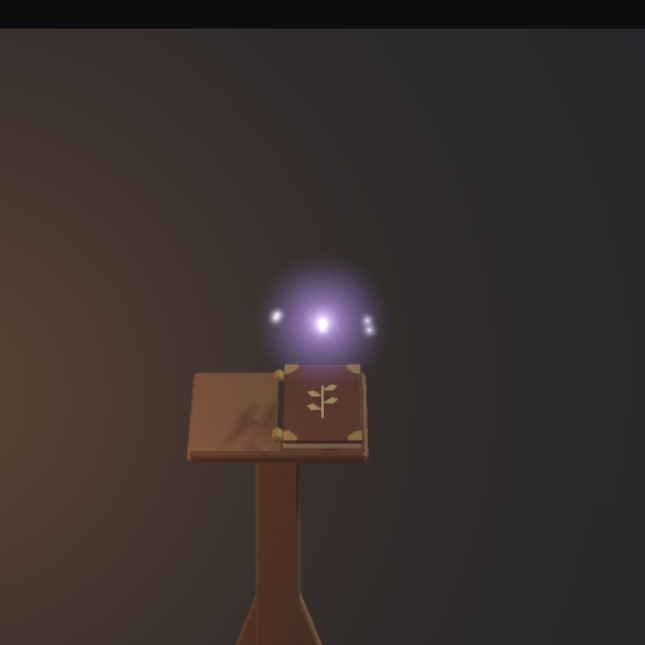
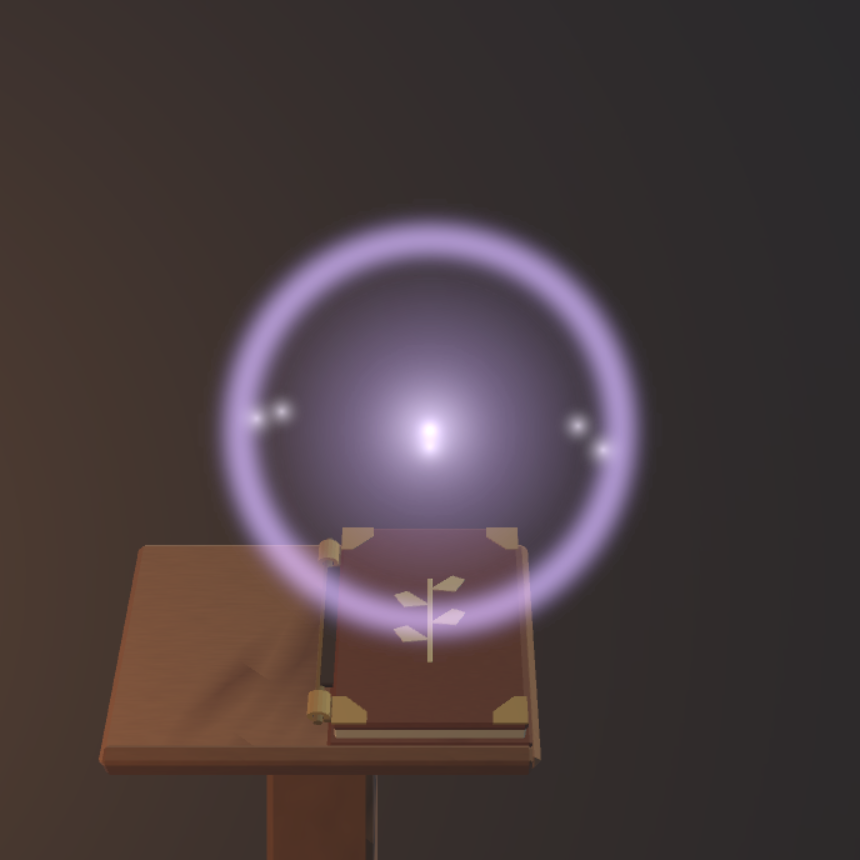
These are renders against a stand-in stone wall, not the hub. They show how bright and how big, not how it sits in the room.
Making the glow bigger also meant it reached the wall behind the journal. The check that guarded this measured where the square quads ended. But a soft glow is invisible near its edge, so a wall cutting it there leaves no seam. The check now measures where the light is actually visible, from the same functions that draw the textures. That gave 0.50 m, and hanging the aura 10 cm toward you clears it.
Pass 49: the glow caught my eye from across the hub, the swell and the pulse "worked really well," I saw the ring and the sparks, and nothing was too bright. It's settled.
The lesson I'm keeping: when you use something you're holding on a target just in front of you, your hand and the object hide whatever is between them. The effect has to happen around the object's outline, and in time with what your hand feels.
Next up are the shadow caches, Astra's latch case and clay jar, which will replace the plain pockets.